
Doctorate In Business Administration Malta (EU)
DBA BESPOKE™
DBA Bespoke™ is a personalised Doctorate in Business Administration model designed around each doctoral learner’s career goals, research direction, and practical application needs. The programme not only supports the completion of a Doctorate in Business Administration qualification in an international academic environment, but also helps doctoral learners develop research work with practical value for business, professional practice, academic publication, expert positioning, capital-raising preparation, research outcome protection, or the transformation of knowledge into practical products.
In a context where knowledge, technology, and business models are changing rapidly, many research projects risk becoming outdated before completion. DBA Bespoke™ is developed to optimise the research journey and shorten the distance between academia and practice, while maintaining the academic standards, assessment requirements, and rigour of an applied Doctorate programme.
Upon successful completion of the programme, learners are awarded the Doctorate in Business Administration degree by EuroAmerican Institute, Malta. Recognition, comparability, or acceptance of the qualification may be considered through relevant national authorities, institutions, employers, professional bodies, or ENIC-NARIC recognition channels, subject to their own regulations and assessment criteria.
Malta is strategically positioned as an international education and business hub in Southern Europe. With GDP per capita among the higher levels in the European Union, Malta combines a British-influenced education tradition with a higher education framework embedded in the Bologna Process and the European Higher Education Area. As a member of the European Union, the Schengen Area, and the Commonwealth, Malta offers a distinctive bridge between British educational heritage and European higher education standards.


DBA Bespoke™
What do you get?
DBA Degree from Malta
Receive the Doctorate in Business Administration degree awarded by EuroAmerican Institute, Malta, upon successful completion of the programme.
Malta (EU) Accredited
The programme operates within Malta’s regulated higher education framework and is referenced at MQF Level 8, aligned with the wider European framework.
Personalised Design
DBA Bespoke™ helps personalise the research journey and research output according to each learner’s goals.
Scholarships Available
Scholarships may be available for eligible applicants, subject to admissions review and the scholarship assessment process.
DBA Bespoke™
Programme Details
Doctorate in Business Administration from EAI Malta
What is DBA Bespoke™?
DBA Bespoke™ is a Doctorate in Business Administration model developed based on the philosophy of personalising the research journey for each doctoral learner. Instead of requiring every learner to follow a common research direction or a fixed dissertation structure, DBA Bespoke™ begins with the learner’s professional background, management experience, personal goals, entrepreneurial orientation, and practical application needs.
With DBA Bespoke™, the doctoral dissertation is not viewed merely as an academic requirement for programme completion. Instead, it is positioned as a doctoral-level research project that may create practical value for the learner, businesses, and professional communities. Therefore, the research work is expected not only to meet academic standards and scholarly requirements, but also to serve a clear practical purpose with long-term value.
Designed according to research objectives
One of the distinctive features of DBA Bespoke™ is its ability to be designed around individual research goals. Depending on the doctoral learner’s orientation, the research project may be developed to support objectives such as:
- exploring research-based entrepreneurship or innovation projects;
- preparing documentation for research outcome protection, where applicable;
- developing a business model for capital-raising preparation or commercialisation;
- building a professional expert profile;
- or preparing a foundation for teaching, consulting, or academic engagement within an international environment.
Personalised research pathway
DBA Bespoke™ is also designed around an individualised research pathway for each learner. The duration and structure of a DBA programme may vary depending on the programme requirements, research scope, learner’s progress, and applicable academic regulations. Through the integration of APEL and the Mapping⁺ model, prior learning, professional experience, research capability, and previously achieved outputs may be mapped against relevant competency and academic requirements.
The purpose of this approach is not to reduce academic standards, but to help learners focus on the most relevant areas needed to complete their doctoral research more effectively.
In a context where knowledge, technology, and markets are changing rapidly, many research topics risk becoming outdated if implementation is too prolonged or disconnected from practical application. DBA Bespoke™ is developed to help doctoral learners focus on research topics with real value and practical relevance, while still maintaining the academic requirements, scholarly standards, and assessment processes of a Doctorate programme.
Additional industry expert support
Another important feature of DBA Bespoke™ is the ability to integrate an additional expert support system aligned with the learner’s research objectives. Some research topics require not only academic supervision, but also insights from industry specialists. Therefore, depending on the research direction and the practical context of each topic, the programme may include the support of industry experts to assist learners in connecting theory, practice, and application goals.
Additional academic support system
In addition, DBA Bespoke™ is supported by an accompanying academic support system designed to help doctoral learners focus more effectively on their core research content. This support system may include:
- academic English support;
- dissertation formatting support;
- support for document presentation and consistency review;
- and support in reducing unintentional plagiarism risks.
These support activities are academic support services only and do not replace the role of supervisors, examination boards, or the awarding institution.
Through the Swiss digital higher education system SwissEdu⁺ and the Mapping⁺ model, DBA Bespoke™ represents a modern approach to personalised doctoral education. The model is designed for leaders, entrepreneurs, management professionals, and doctoral learners with substantial professional experience who wish to transform their experience, thinking, and practical challenges into research work with lasting value.
SwissEdu⁺ is positioned as an innovative system in personalised education models, in which DBA Bespoke™ is developed as a distinctive doctoral programme model designed to address the needs of multiple stakeholders, including academic institutions, funding organisations, investors, and potential users of research outcomes.
Distinctive Advantages of DBA Bespoke™
DBA Bespoke™ creates distinctive value by combining a Doctorate in Business Administration qualification awarded within Malta’s higher education system with a personalised research model designed around each doctoral learner’s individual goals. The programme not only aims to support the completion of a Doctorate qualification in an international academic environment, but also helps learners develop research work with practical value for professional, business, investment, academic, or broader applied objectives.
1. Qualification awarded within Malta’s higher education system
One important advantage of DBA Bespoke™ is that the Doctorate in Business Administration qualification is awarded by an education institution in Malta and positioned within Malta’s higher education system.
- Malta is a member of the European Union, the Schengen Area, the Commonwealth, and the European Higher Education Area through the Bologna Process.
- A DBA qualification from Malta may support doctoral learners in presenting a Doctorate-level qualification within a European higher education context.
This can be an important advantage for doctoral learners who need an international qualification to support academic, professional, teaching, consulting, or career development purposes in a multinational environment.
The recognition, use, or evaluation of the qualification in each country, organisation, or professional context remains subject to the regulations and assessment criteria of the receiving authority.
2. Personalising the dissertation according to the learner’s real objectives
DBA Bespoke™ does not view the doctoral dissertation merely as an academic requirement for programme completion. Instead, the dissertation is positioned as a doctoral-level research project designed to create practical value for the learner, businesses, and professional communities.
- The research project may be oriented toward supporting research-based entrepreneurship or innovation projects.
- Research outcomes may be structured to support intellectual property protection or development, where applicable.
- The dissertation may be developed into a business model to support capital-raising preparation or commercialisation.
- The research work may support the development of an expert profile, professional positioning, or preparation for becoming an entrepreneurial lecturer within an international environment.
3. Personalised research pathway
DBA Bespoke™ is designed around a personalised research pathway for each learner, based on their academic background, management experience, research capability, and previous outputs.
The duration and structure of a DBA programme may vary depending on the programme requirements, research scope, learner’s progress, dissertation completion requirements, and applicable academic regulations. Through the APEL model and the Mapping⁺ approach, doctoral learners may be considered for research pathway optimisation based on learning outcomes or competencies previously demonstrated through experience, research capability, or prior academic outputs.
This process does not reduce academic standards. Instead, it helps doctoral learners focus on the most relevant areas needed to complete their doctoral research more effectively, with greater focus and stronger alignment with practical objectives.
4. Reducing the risk of outdated research
In a context where knowledge, technology, and markets change rapidly, many research topics may become outdated if the research process is too prolonged or lacks practical relevance.
- DBA Bespoke™ helps doctoral learners focus on research issues that remain valuable at the time of study.
- The pathway is designed to connect research more closely with the practical needs of businesses, markets, or professional sectors.
- The programme helps reduce the risk of fragmented research that becomes disconnected from practice or less relevant by the time of completion.
While focusing on effectiveness and application, the programme still maintains the academic requirements, scholarly standards, and assessment procedures of a Doctorate programme.
5. Additional expert support in the research field
Some DBA topics are highly specialised and require not only academic supervision, but also insights from industry experts.
- Depending on the research direction and the feasibility of each case, the programme may include additional expert support alongside academic supervision.
- Industry experts can help learners connect academic theory with practical issues and application objectives.
This accompanying support helps the dissertation better reflect real business needs, investment thinking, market requirements, or the context in which the research outcomes may be applied.
The role of experts is supportive only and does not replace the supervisor, examination board, or awarding institution.
6. Accompanying academic support system
DBA Bespoke™ is complemented by an accompanying academic support system designed to help doctoral learners focus more effectively on their core research content.
This support system may include:
- academic English support during the preparation and completion of research documents;
- dissertation formatting support and standardisation of academic presentation and structure;
- support in checking the presentation format, logic, and consistency of research materials;
- support in reducing unintentional plagiarism risks through review, guidance, and standardisation of reference materials.
These support activities are academic support services only and do not replace the role of supervisors, examination boards, or the awarding institution.
7. Suitable for multiple stakeholders connected to research outcomes
DBA Bespoke™ does not serve only the learner, but may also address the needs of multiple stakeholders connected to the research outcomes.
- For doctoral learners, the programme helps transform experience, management thinking, and practical challenges into a structured research project.
- For academic communities, the programme may generate structured research work with methodology and potential applied knowledge contribution.
- For sponsors, the programme may help link investment in learning and research to specific, measurable, and usable outcomes.
- For investors, research outcomes may provide a basis for assessing a business model, market opportunity, or commercialisation potential.
- For organisations using research outcomes, the DBA research project may support improvements in governance, operational models, product development, policy design, or new strategic implementation.
8. Advantages from SwissEdu⁺ and the Mapping⁺ model
Through the Swiss digital higher education system SwissEdu⁺ and the Mapping⁺ model, DBA Bespoke™ positions itself as a modern and personalised Doctorate-level model.
- SwissEdu⁺ supports the development of a flexible digital education ecosystem, where the research pathway may be designed in closer alignment with each learner’s background.
- Mapping⁺ helps connect prior experience, capability, outputs, and research objectives with the academic requirements of the programme.
This model helps doctoral learners not only pursue a qualification, but also develop research work with professional, business, and academic value. DBA Bespoke™ is therefore suitable for leaders, entrepreneurs, management professionals, and doctoral learners with substantial experience who wish to transform their experience, thinking, and practical challenges into research work with lasting value.
The core advantage of DBA Bespoke™ lies in the combination of a Doctorate-level qualification awarded in Malta, the personalised research model of SwissEdu⁺, the Mapping⁺ approach, and the support of supervisors and accompanying experts. This makes DBA Bespoke™ suitable for a new generation of research learners who need not only a Doctorate qualification, but also a research project that can serve real objectives, create practical impact, and deliver long-term value.
DBA Bespoke™ Research Pathway
DBA Bespoke™ is designed as a personalised Doctorate in Business Administration programme, beginning with each doctoral learner’s real needs and progressing toward the completion and defence of the research work, where required, before an academic or examination panel. Similar to the philosophy applied in the personalised M.Phil model, DBA Bespoke™ does not place doctoral learners into a fixed template. Instead, the programme builds a personalised research journey based on their academic background, management experience, career objectives, business orientation, and the applied value they wish to achieve after completing the programme.
1. Research Needs Consultation
The first stage of DBA Bespoke™ is research needs consultation. This is a foundational step, because a personalised DBA programme cannot begin with a pre-set topic. The research journey must be built from a core question: why does the learner pursue a DBA, and what purpose should the final research work serve?
At this stage, learners are supported in clarifying their academic background, management experience, area of expertise, business context, and the practical problem they wish to address through doctoral research. The aim is not only to choose a suitable topic, but also to define the final value of the research work, such as developing a business model, building an expert profile, preparing for academic publication, capital-raising preparation, commercialisation planning, preparing documentation for intellectual property protection where applicable, or building a foundation for teaching, consulting, or academic engagement in an international environment.
This is also the stage for assessing the learner’s readiness in terms of time, research capability, academic English, data availability, implementation resources, and the ability to apply research outcomes in practice.
2. Building a Personalised DBA Bespoke™ Research Journey
Once the research needs have been identified, the programme supports the development of a personalised DBA Bespoke™ research journey for each doctoral learner. This step transforms the initial objectives into a structured and feasible research plan that aligns with the academic requirements of the Doctorate programme.
The personalised research journey usually includes research topic orientation, research questions, research objectives, research scope, and appropriate research methodology. At the same time, the programme may consider the learner’s academic background, management experience, research capability, and previously achieved outcomes through the APEL and Mapping⁺ model, with the aim of optimising the research process while maintaining academic standards.
The key point of this stage is that doctoral learners do not merely receive a study plan. Instead, they receive a personalised research map. This map helps learners understand the entire journey from the initial idea to the research proposal, literature review, methodology design, data collection and analysis, dissertation writing, defence preparation, and development of outputs from the research work.
3. Conducting Research According to the Personalised Research Journey
Once the personalised research journey has been established, doctoral learners begin conducting research according to the defined plan. This is the core stage of DBA Bespoke™, where learners develop doctoral-level research in accordance with academic requirements and the applied objectives identified from the beginning.
During this process, doctoral learners gradually complete the research proposal, build the theoretical framework, conduct the literature review, identify the research gap, design the research methodology, collect and analyse data, and then develop the research findings into outputs with academic and practical value. The DBA dissertation is completed based on feedback from the supervisor, academic unit, and, where appropriate, consulting experts in the relevant field.
The distinctive feature of DBA Bespoke™ is that doctoral learners do not follow a generic template. The entire research process is designed around their objectives, capabilities, data, experience, and practical context. As a result, the research work can be more focused, more substantive, and less exposed to the risk of becoming fragmented or outdated in a rapidly changing knowledge, technology, and market environment.
4. Defending the Research Outcomes Before an Academic or Examination Panel
After the dissertation has been completed in accordance with the required standards, doctoral learners proceed to the stage of defending their research outcomes before an academic or examination panel, where required by the programme regulations. This step confirms the academic quality, independence, research methodology, analytical results, and contribution value of the work.
At this stage, doctoral learners need to present the logic of their research, the rationale for topic selection, theoretical basis, research methodology, data used, analytical results, and the contribution of the dissertation. The panel evaluates not only the completeness of the work, but also the learner’s ability to defend arguments, explain findings, and demonstrate in-depth understanding of the research problem.
The dissertation defence is not merely the final procedure for programme completion. It is the point at which doctoral learners demonstrate that their work reaches doctoral level, has academic quality, demonstrates independence, and has the potential to contribute to management practice or the relevant professional field.
5. Receiving the Doctorate in Business Administration from EAI Malta
After completing all academic requirements, successfully defending the research outcomes where required, and meeting relevant programme regulations, doctoral learners may be considered for the award of the Doctorate in Business Administration by EuroAmerican Institute, Malta.
The Doctorate in Business Administration awarded by EAI Malta represents the final outcome of the full research journey. It recognises the learner’s applied research capability at doctoral level and may serve as a foundation for long-term professional, academic, and practical development.
The DBA Bespoke™ programme structure consists of five main stages: research needs consultation, development of a personalised DBA Bespoke™ research journey, research implementation according to the personalised research journey, defence of research outcomes before an academic or examination panel where required, and consideration for the award of the Doctorate in Business Administration by EuroAmerican Institute, Malta.
With this structure, DBA Bespoke™ is not merely a Doctorate in Business Administration programme. It is a personalised research journey designed to help doctoral learners transform their experience, career goals, and practical problems into doctoral-level research with academic, professional, and long-term applied value.
Qualification Awarded
Upon graduation, students will receive:
- Doctorate in Business Administration awarded by EuroAmerican Institute, Malta.
Eligible learners may optionally register to receive the Master of Philosophy (M.Phil.), subject to the applicable academic regulations.
Specialisations
Doctoral students may be allowed to select a specialisation based on the topic and scope of their dissertation, subject to academic review and approval.
Please note that the selected specialisation will be recorded on the academic transcript only and will not appear on the qualification. The final wording may be adjusted depending on the actual dissertation topic and the decision of the Academic Board. Doctoral students may also choose to complete the programme without a specified research major if they prefer to receive a general doctoral award without a specialised designation.
Doctoral students may select from the following possible areas of specialisation, subject to the relevance of their dissertation topic and academic approval:
- Artificial Intelligence in Business
- Digital Transformation
- Corporate Finance
- Banking Leadership
- International Business
- Healthcare Management
- Educational Leadership
- EdTech and Training Management
- Organisational Psychology
- Pharmaceutical Management
- Management Information Systems
- Business Analytics
- Logistics and Supply Chain Management
- Marketing and Brand Management
- Human Resource Management
- Investment and Wealth Management
- Entrepreneurship and Innovation
- Educational Experience Design
Entry Requirements
Admission through the typical route:
- Applicants must be over 24 years of age;
- A Master’s degree in any discipline from an accredited university;
- Or a Level 7 qualification under the European Qualifications Framework (EQF) or an equivalent qualification.
Admission through the special route:
- Hold a Bachelor’s degree;
- Be at least 35 years old with 10 or more years of management experience; or
- Be at least 30 years old with 5 or more years of experience in a C-level or equivalent leadership experience (e.g. CEO, CFO, CHRO, CPO, Managing Director, Executive Director position within the organization)
- Pass the APEL.A assessment route (support provided).
English Requirements:
- English proficiency must be at least CEFR (Common European Framework of Reference) level B2 or IELTS 5.5
Learning Mode
Learners attend Live Class directly with lecturers from Swiss Information and Management Institute under the Live Class Direct™ model. Upon successful completion of the programme, learners receive the Doctorate in Business Administration (DBA) awarded by EuroAmerican Institute (EAI), Malta.
The programme is delivered through the SwissEdu⁺ Swiss Digital Higher Education model, in which Swiss Information and Management Institute focuses on academic delivery and learner support, while the qualification is awarded by EAI Malta.
The Live Class Direct™ model enables learners to study directly with Swiss Information and Management Institute, without franchise delivery or intermediaries. This helps maintain the original programme structure, ensure direct academic access, and reduce third-party delivery risks.
DBA Bespoke™
Accreditation & Recognition of EAI Malta (EU)
Recognised by the Malta Further & Higher Education Authority (MFHEA)
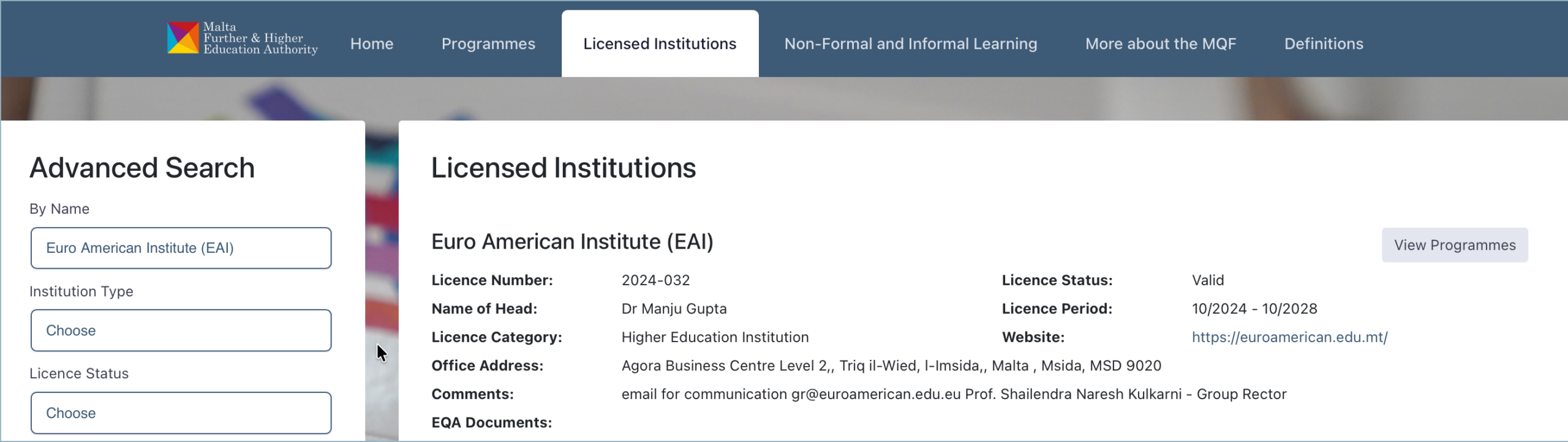
EuroAmerican Institute (EAI) Malta is licensed and accredited by the Malta Further and Higher Education Authority (MFHEA), the competent authority responsible for the licensing, accreditation, and quality assurance of further and higher education in Malta.
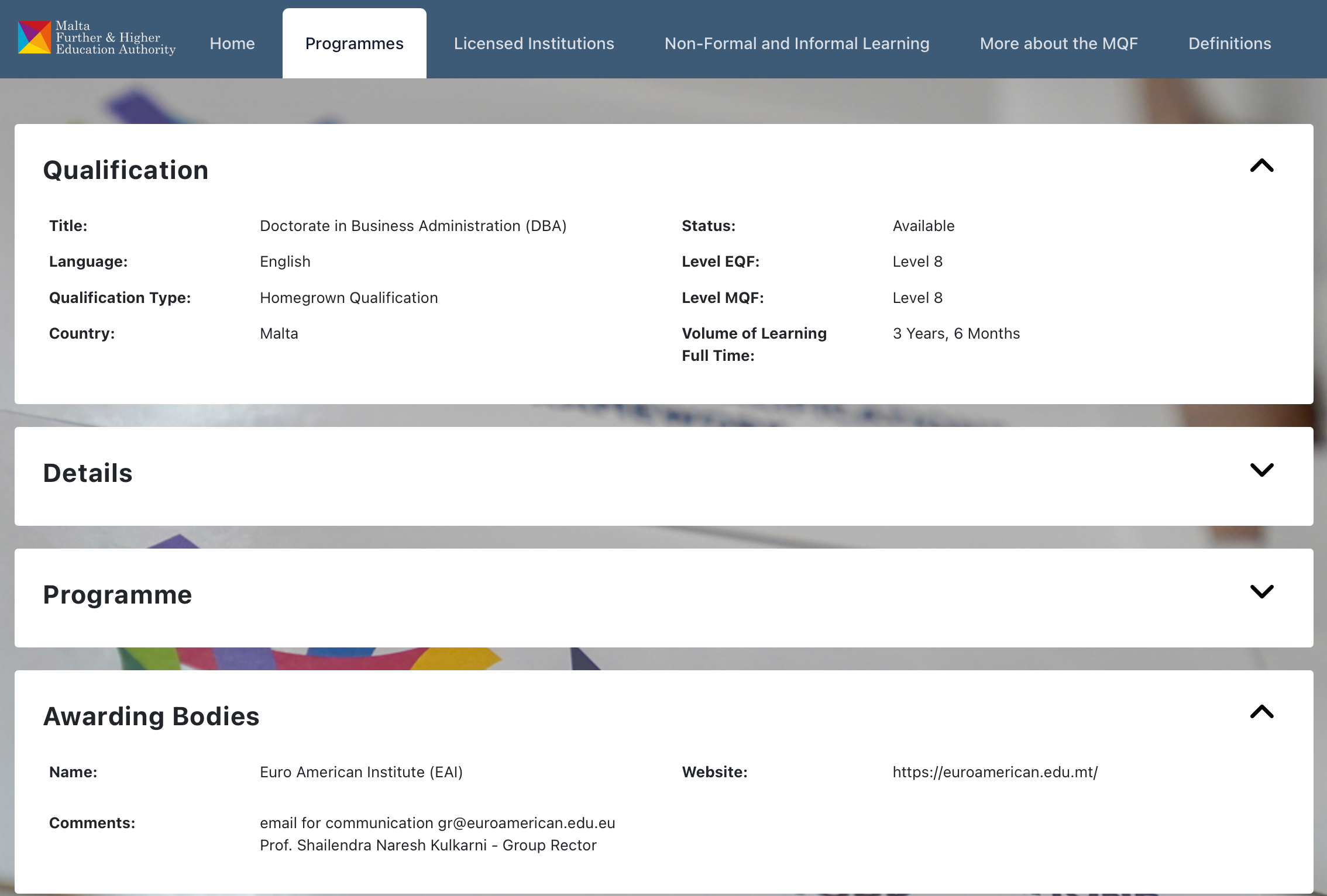
Under Higher Education Institution Licence No. 2024-032, EAI is licensed to operate as a Higher Education Institution in Malta. Its approved programmes are offered within the Malta Qualifications Framework (MQF) and referenced to the European Qualifications Framework (EQF), subject to the applicable MFHEA regulatory requirements.
As a higher education provider based in Malta, EAI operates within a country that is part of the European Union and the European Higher Education Area (EHEA). Its programmes may be structured using ECTS credits in line with European higher education practices, supporting transparency and comparability.
MFHEA oversees licensing, programme accreditation, and quality assurance in accordance with Malta’s regulatory framework for further and higher education. Programmes are referred to as accredited when they have been assessed by MFHEA and pegged to the Malta Qualifications Framework.
Recognition of the Online Learning Model - Aligned with SwissEdu⁺’s Swiss Digital Higher Education Framework
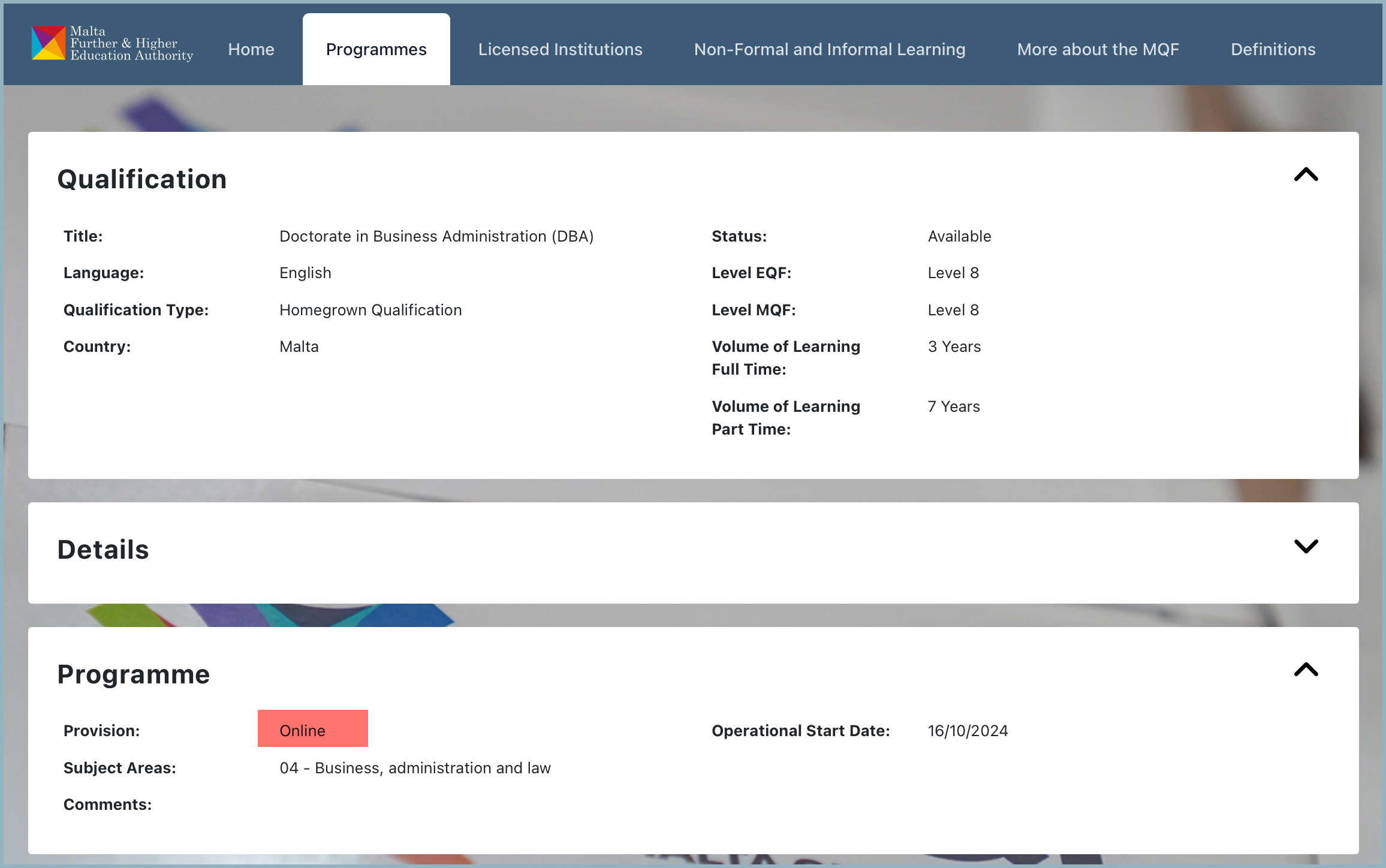
The programme is not only academically accredited; the online learning model for the Doctor of Business Administration (DBA) programme has also been approved by the Malta Further and Higher Education Authority (MFHEA).
This is an important distinction. As SwissEdu⁺ delivers its global learning model under the concept of Swiss Digital Higher Education, approval of the programme’s online delivery model helps provide a formal and recognised framework for online study and academic delivery, supported by MFHEA’s regulatory oversight.
Verify MFHEA’s approval of the online delivery model HERE.
European Qualifications Framework (EQF) and the Bologna Process
EAI qualifications are pegged to the Malta Qualifications Framework (MQF), which is referenced to the European Qualifications Framework (EQF). This supports transparency and comparability in international academic contexts.
The Lisbon Recognition Convention is the principal legal instrument for the recognition of higher education qualifications in the European region. It is administered by the Council of Europe and UNESCO and, as of 1 July 2025, has 57 Contracting Parties. Recognition decisions remain subject to the policies of the receiving institution or competent authority.
As part of the broader European higher education architecture associated with the Bologna Process, ECTS may be used to support transparency, comparability, and credit transfer. In Malta, recognition information is provided through MQRIC, the official ENIC-NARIC centre within MFHEA.
- Reference to the Malta ENIC–NARIC Network HERE
European Credit Transfer and Accumulation System (ECTS)
Malta is a member of the Bologna Process and part of the European Higher Education Area (EHEA). Within this framework, ECTS supports transparency, credit accumulation and transfer, and the recognition of study periods across European higher education systems.
The European Qualifications Framework (EQF) serves as a common reference framework to make qualifications easier to understand and compare across Europe.
As a licensed higher education institution in Malta, EAI may award qualifications within the scope of its licence and accredited programmes. These qualifications may be considered for recognition by receiving institutions or competent authorities, subject to their own rules and procedures.
- Information on ECTS HERE
MFHEA and ENQA
The Malta Further and Higher Education Authority (MFHEA) is an Affiliate Member of the European Association for Quality Assurance in Higher Education (ENQA).
ENQA is a European association dedicated to quality assurance in higher education and plays an important role in the development of quality assurance policy and cooperation within the European Higher Education Area (EHEA).
MFHEA’s Affiliate Member status reflects its participation in the wider European quality assurance community and its engagement with quality assurance developments associated with the Bologna Process and the ESG 2015 framework.
- Information on MFHEA and ENQA HERE
Recognition Information via ENIC-NARIC
The ENIC-NARIC Networks bring together national information centres that provide information and guidance on the recognition of qualifications across participating countries. These networks operate within the broader framework of the Lisbon Recognition Convention.
In Malta, the Malta Qualifications Recognition Information Centre (MQRIC), within the Malta Further and Higher Education Authority (MFHEA), is the official ENIC-NARIC centre. It provides recognition and comparability advice for qualifications and assists with the recognition of Maltese qualifications abroad.
Accordingly, qualifications awarded by licensed and, where applicable, accredited higher education providers in Malta may be considered for academic or professional recognition by receiving institutions or competent authorities, subject to their own rules and procedures.
- For further information on ENIC–NARIC, please visit HERE
Recognition of Comparability in South Africa
South African Qualifications Authority (SAQA) is the statutory authority responsible for the management and oversight of the South African National Qualifications Framework (NQF), and for ensuring compliance with national values and quality standards within the qualifications recognition system.
According to SAQA’s comparability assessment outcomes, a Doctoral qualification awarded in Malta, Europe is recognised by SAQA as a Doctoral qualification within the national qualifications benchmarking system, in accordance with South Africa’s assessment framework and recognition criteria.
Such recognition is carried out within the scope of SAQA’s statutory authority and serves academic benchmarking, professional, and qualifications management purposes, in line with the official assessment procedures of South Africa’s national qualifications authority.
- View more HERE
Recognition of Comparability in New Zealand
The New Zealand Qualifications Authority (NZQA) is the national authority responsible for maintaining the New Zealand Qualifications and Credentials Framework (NZQCF) and for evaluating overseas qualifications through its International Qualification Assessment (IQA) process.
Where an overseas qualification is submitted to NZQA for assessment, NZQA may evaluate how that qualification compares with a qualification type or level on the NZQCF, based on the individual case and the evidence provided.
In New Zealand, a Doctoral Degree is positioned at Level 10 on the NZQCF. Any comparison between an overseas doctoral qualification and a New Zealand Doctoral Degree should therefore be presented only on the basis of a specific NZQA assessment outcome.
This assessment is conducted under NZQA’s official procedures and is not automatic. The outcome depends on the qualification submitted and the supporting documentation provided.
- View more HERE
Recognition of Comparability in Italy
The Automatic Recognition Database Italia (ARDI) is a tool developed by CIMEA to support the automatic correspondence of qualifications issued in countries that are signatories to the Lisbon Recognition Convention. It is designed in line with the European approach to automatic recognition in higher education.
Through ARDI, eligible qualifications may obtain a statement of correspondence with the relevant level of the Italian higher education system, subject to the scope of the database and the applicable procedures of the receiving institution or competent authority.
Where applicable, doctoral-level qualifications may be referenced in line with the third cycle of the Qualifications Framework of the European Higher Education Area (QF-EHEA), depending on the specific qualification and the official ARDI result.
This supports academic progression and recognition processes in Italy, subject to the rules and authority of the relevant Italian institution or authority.
- View more HERE
Recognition of Comparability in Lithuania
Study Quality Evaluation Center – Lithuania’s authority for the evaluation and quality assurance of education – has conducted an Education Credential Assessment (ECA) for qualifications awarded in Malta.
According to the relevant assessment outcome, the DBA qualification awarded in Malta may, in an individual case, be recognised at a level comparable to a doctoral qualification within the Lithuanian qualifications system, subject to the official decision of the competent authority.
- View more HERE
Recognition of Comparability in Australia
Educational Qualification Assessment
Qualifications awarded by higher education institutions in Malta (Europe) may be assessed by relevant Australian qualification assessment authorities for comparability in terms of level within the Australian Qualifications Framework (AQF), depending on the purpose of assessment and the documentation provided.
Such assessment is conducted through the official procedures of the relevant Australian authority or assessment body and may support applications for further study, employment, professional review, and/or migration, subject to the requirements of the receiving institution, profession, or authority.
- View more HERE
Recognition of Comparability in Nigeria
Electronic Transcript Exchange and Certificate Verification System (Nigeria)
Nigeria’s Electronic Transcript Exchange and Certificate Verification System has carried out an assessment in relation to qualifications awarded in Malta.
According to the assessment results, doctoral qualifications from Malta may be considered comparable to doctoral-level qualifications within the Nigerian education system. This indicates comparability for the purposes of qualification verification, further study, and/or professional use, subject to the rules and authority of the receiving system.
- View more HERE
Recognition of Comparability in Norway
Norwegian Directorate for Higher Education and Skills (Norway)
The Norwegian Directorate for Higher Education and Skills (HK-dir) is the competent authority in Norway for the recognition of foreign higher education qualifications.
Qualifications awarded by higher education institutions in Malta (Europe) may be assessed by HK-dir to determine whether they can be considered equivalent, in level and scope, to higher education qualifications within the Norwegian system, in accordance with the applicable regulations and assessment criteria.
Such assessment is carried out through official procedures and may support applications for further study, employment, or institutional and professional review, subject to the documentation submitted and the requirements of the receiving institution, employer, profession, or authority.
- View more HERE
Recognition of Comparability in the UK
UK National Information Centre for the Recognition and Evaluation of International Qualifications and Skills (UK ENIC)
UK ENIC is the United Kingdom’s national information centre for the recognition and evaluation of international qualifications and skills. The service is operated by Ecctis on behalf of the UK Department for Education.
Based on UK ENIC assessment procedures, qualifications awarded in Malta may be assessed as comparable to qualifications at the corresponding level within the United Kingdom’s qualifications system, depending on the specific qualification and supporting documentation.
For example, an overseas doctoral qualification may be assessed by UK ENIC as comparable to a UK doctoral qualification for academic and professional comparison purposes, subject to the specific case and UK ENIC’s assessment process.
- View more HERE
Recognition of Comparability in the United Arab Emirates
The UAE Ministry of Education (MoE) operates the recognition system for university certificates issued outside the United Arab Emirates, subject to the applicable regulations, documentation requirements, and the scope of review of the competent authority.
Recognition is not automatic and depends on the nature of the qualification, the submitted documents, and the requirements of the relevant authority or institution in the UAE.
- View more HERE
Recognition of Comparability in Finland
Finnish National Agency for Education (Finland)
The Finnish National Agency for Education may assess qualifications awarded in Malta as comparable, in terms of level, to qualifications within the Finnish higher education system, depending on the specific qualification and the purpose for which recognition is sought.
Such recognition or comparability is considered in accordance with the authority and assessment procedures applicable in Finland, for academic and/or professional purposes. It is not automatic and depends on the specific qualification file, the intended use of the qualification, and the rules of the receiving institution, employer, or competent authority.
- View more HERE
Recognition of Comparability in Poland
Polish National Agency for Academic Exchange (Poland)
The Polish National Agency for Academic Exchange has recognised qualifications awarded by higher education institutions in Malta (Europe) as being at the corresponding comparable level within the Polish higher education system.
Specifically, the doctoral qualification has been identified as comparable to third-cycle studies in Poland, in accordance with the applicable qualifications framework and recognition regulations of the Polish higher education system.
Such recognition is carried out under the authority and assessment procedures of the receiving body for the purposes of further study and/or professional use, and is not automatic, but depends on each individual case.
- View more HERE
Recognition of Comparability in France
French Republic (France)
France, through ENIC-NARIC France, participates in the ENIC-NARIC Networks, the international network for information and recognition of qualifications operating in line with the principles of the Lisbon Recognition Convention.
Within this framework, qualifications awarded in Malta may be assessed as being at a corresponding comparable level for academic and/or professional purposes, subject to the authority and assessment procedures of the receiving institution or competent authority in France.
- View more HERE
Recognition of Comparability in the Netherlands
Internationale Diplomawaardering (Netherlands)
International Credential Evaluation (IDW) is the Dutch service for evaluating foreign diplomas by comparing them with the Dutch education system. A credential evaluation indicates which level in the Dutch education system is comparable to a foreign diploma.
Qualifications awarded by higher education institutions in Malta (Europe) may be evaluated for comparability with Dutch higher education qualifications, in accordance with the applicable evaluation procedures and the principles used in the Netherlands.
Where relevant, a Master’s qualification may be evaluated as comparable to a Dutch Master’s degree, depending on the specific qualification, supporting documentation, and the outcome of the individual assessment.
A credential evaluation is an official assessment document, but it is not legally binding and does not in itself guarantee admission, employment, or automatic recognition. Final decisions remain subject to the requirements of the receiving institution, employer, profession, or authority.
- View more HERE
Recognition of Comparability in Sweden
Swedish Council for Higher Education (Sweden)
The Swedish Council for Higher Education is Sweden’s centre within the ENIC-NARIC Networks, the international cooperation framework for information and recognition of qualifications, operating in line with the principles of the Lisbon Recognition Convention.
Within this framework, qualifications awarded in Malta may be assessed by the Swedish Council for Higher Education as comparable to qualifications at the corresponding level in the Swedish education system, for academic and/or professional comparison purposes, subject to the authority and assessment procedures applicable in Sweden.
- View more HERE


DBA Bespoke™
Frequently Asked Questions
SwissEdu⁺
What is DBA Bespoke™?
DBA Bespoke™ is a Doctorate in Business Administration programme designed around the philosophy of personalising the research journey for each doctoral learner. Instead of applying a fixed research topic or structure, the programme begins with each learner’s professional background, management experience, personal goals, business orientation, and practical application needs.
The distinctive feature of DBA Bespoke™ is that the dissertation is not viewed only as an academic requirement for programme completion, but also as a doctoral-level research project that may create practical value for the learner, businesses, and professional communities.
How is DBA Bespoke™ different from a traditional DBA model?
A traditional DBA programme is usually delivered through a relatively fixed research structure, where doctoral learners develop their dissertation according to the programme’s general academic process. DBA Bespoke™ still maintains the academic requirements of a Doctorate programme, while adding a stronger level of personalisation in defining research objectives, designing the research journey, and orienting the application of research outcomes.
With DBA Bespoke™, the research topic and research journey are developed based on each doctoral learner’s experience, capabilities, career goals, and practical problems. As a result, the research work may serve more specific objectives, such as developing a business model, building an expert profile, preparing for academic publication, capital-raising preparation, commercialisation planning for research outcomes, or preparing documentation for intellectual property protection.
Is this programme suitable for me?
DBA Bespoke™ is suitable for leaders, entrepreneurs, senior managers, consultants, entrepreneurial lecturers, and experienced professionals who wish to transform their practical experience into doctoral-level research work.
The programme is especially suitable for learners who are not only seeking a DBA qualification, but also want their research work to may create practical value for business, professional practice, academic development, or long-term development projects.
Can applicants without a well-defined research topic join the programme?
Yes. One of the important features of DBA Bespoke™ is the research needs consultation stage before the formal research process begins. At this stage, learners are supported in clarifying their academic background, management experience, area of expertise, career goals, and the practical problem they wish to address.
Through this process, the programme supports learners in orienting their research topic, defining research objectives, research scope, and a suitable implementation plan.
Is DBA Bespoke™ a “shortened programme for obtaining a degree faster”?
No. DBA Bespoke™ is not a programme that reduces academic standards or simplifies Doctorate-level requirements. The personalisation of the research journey is designed to help doctoral students focus on the most relevant areas for development, while avoiding unnecessary repetition of content that has already been demonstrated through prior experience, competencies, or academic outcomes.
Through the APEL and Mapping⁺ model, the programme may consider the student’s academic background, management experience, research capability, and previously achieved outcomes to optimise the research journey. However, all final outcomes must still meet the academic requirements, scholarly standards, assessment procedures, and dissertation defence requirements of the DBA programme.
How long does it take to complete the programme?
The completion time depends on each doctoral student’s academic background, research experience, topic readiness, data availability, academic writing ability, and research progress. Typically, a DBA programme may take approximately 2 to 5 years, depending on the programme structure and applicable academic regulations.
With DBA Bespoke™, the research journey may be optimised through APEL and Mapping⁺, helping doctoral students focus on the areas that need to be developed to complete their research work. However, the actual duration still depends on the quality of the research, required revisions, feedback progress, assessment process, and academic decisions of the awarding institution.
What does APEL mean in DBA Bespoke™?
APEL is a process for reviewing a student’s prior experience, competencies, learning outcomes, or research outputs to support admission, research orientation, and optimisation of the research journey.
In DBA Bespoke™, APEL does not mean exemption from all research requirements or a guarantee of faster completion. The role of APEL is to help identify competencies that have already been demonstrated, thereby supporting the development of a research journey that is more suitable for each doctoral student’s academic and professional background.
What is Mapping⁺ in DBA Bespoke™?
Mapping⁺ is a support model that connects each doctoral student’s academic background, management experience, research capability, personal goals, and expected outputs with the academic requirements of the programme.
In DBA Bespoke™, Mapping⁺ helps design a personalised research map, allowing doctoral students to clearly understand what they already have, what they need to further develop, the research direction they may follow, and the objectives their final research work may serve.
What objectives can a DBA Bespoke™ dissertation serve?
Depending on each doctoral student’s orientation, the DBA Bespoke™ dissertation may be designed to serve different objectives. For example, the research work may support business model development, practical management problem-solving, expert profile building, preparation for entrepreneurial lecturer profiling, academic publication, capital-raising preparation, commercialisation planning for research outcomes, research-based entrepreneurship or innovation projects, or preparation of documentation for intellectual property protection, where applicable.
The important point is that the application objective must be designed in alignment with academic requirements, data, research methodology, and the doctoral student’s practical implementation capacity.
Does the programme support topic selection?
Yes. The initial consultation stage of DBA Bespoke™ is designed to support doctoral students in identifying a suitable research topic or research direction. Topic selection is based on the student’s academic background, management experience, area of expertise, data availability, career goals, and expected application value.
However, the final topic must meet the programme’s academic requirements and be subject to feasibility, originality, applicability, and the relevant academic approval process.
Does the programme provide supervisors?
Yes. Doctoral students are guided during the development of their research work. The role of the supervisor is to support students in developing the research proposal, selecting an appropriate research methodology, completing the dissertation, and preparing for the academic assessment process.
Depending on the topic and feasibility of each case, the programme may also include additional industry experts to support doctoral students in connecting academic theory with practical needs.
Do industry experts replace supervisors?
No. Industry experts only play a supporting role, helping doctoral students better understand the practical context, market needs, operating models, commercialisation considerations, or application of research outcomes.
Primary academic responsibility remains with the supervisor, examination panel, and awarding institution. Industry experts do not replace the academic process, do not determine assessment outcomes, and do not replace the dissertation defence panel.
Does the programme support academic English and dissertation formatting?
Yes. DBA Bespoke™ may be supported by an accompanying academic support system, including academic English support, dissertation formatting support, standardisation of presentation format, consistency review, and support in reducing unintentional plagiarism risks.
These activities are academic support services designed to help doctoral students present their work more clearly, consistently, and professionally. They do not replace the doctoral student’s responsibility for research, dissertation writing, academic citation, or maintaining the originality of the research work.
Does the programme support academic publication?
Depending on the doctoral student’s research direction and capability, the DBA Bespoke™ research work may be developed into academic articles, conference papers, monographs, or other scholarly outputs. The programme may support academic orientation, article structure, formatting guidance, and the selection of a suitable publication strategy.
However, publication acceptance depends on the quality of the paper, the requirements of the journal or conference, the peer-review process, and the independent decision of the publisher. The programme does not guarantee publication in any specific journal.
Is DBA Bespoke™ suitable for entrepreneurs who want to raise capital?
It may be suitable if the research topic is designed in the right direction. For entrepreneurs or founders, the DBA research work may be developed to clarify the business model, assess the market, test management assumptions, build a growth strategy, analyse customer data, or strengthen the academic foundation for a commercialisation project.
However, DBA Bespoke™ is a Doctorate-level academic programme, not a fundraising programme. Research outcomes may support a fundraising profile or commercialisation strategy, but successful capital raising depends on many factors beyond the academic scope.
Can DBA Bespoke™ be used to register protection for research outcomes?
In some cases, research outcomes may be oriented toward being structured as intellectual property assets or supporting the intellectual property registration process. This depends on the nature of the work, its novelty, applicability, legal requirements, and the requirements of the competent authority.
The programme may support research orientation and help present the outcomes in a clearer and more structured manner. However, registration, issuance of protection certificates, or recognition of intellectual property ownership falls under the authority of the relevant competent authorities and is not guaranteed by the DBA programme.
Can DBA Bespoke™ support an application for science and technology enterprise status?
The research work may be designed to support the development of a knowledge base, model, solution, or research outcome that can contribute to an application for science and technology enterprise status. This is one of the applied objectives that DBA Bespoke™ may consider when designing the research journey.
However, recognition as a science and technology enterprise depends on the laws, conditions, documentation requirements, review process, and decisions of the competent authority in each country or jurisdiction. The programme does not replace legal services, licensing consultancy, or guarantee registration outcomes.
Can I enrol in a doctoral programme with a Bachelor’s degree?
Yes.
A special entry pathway is available for Bachelor’s degree holders who meet one of the following requirements:
- At least 35 years old with 10 or more years of management experience; or
- At least 30 years old with 5 or more years of experience in a C-level or equivalent leadership experience (e.g. CEO, CFO, CHRO, CPO, Managing Director, Executive Director position within the organization)
If I am admitted through special admission from a Bachelor’s degree, can I obtain an additional Master’s degree after completing the Doctorate?
Yes.
Subject to the applicable academic regulations, learners admitted through the special-admission route from a Bachelor’s degree may, upon successful completion of the Doctorate in Business Administration (DBA), optionally register for the additional Master of Philosophy (M.Phil.) award from EuroAmerican Institute (EAI), Malta (EU).
This qualification forms part of Malta’s higher education system and is nationally recognised in Malta.
The Master of Philosophy (M.Phil.) is positioned at MQF Level 7 within the Malta Qualifications Framework, subject to the approved programme structure and applicable regulations. The M.Phil. is a research-oriented Master’s-level qualification and typically has a stronger research focus than many taught or applied Master’s programmes, such as an MBA.
The registration and issuance of this additional qualification are subject to EAI’s current academic regulations and applicable MFHEA/MQF requirements, which may be amended from time to time. The registration and additional issuance fee is not included in the programme tuition fee and is entirely optional.
How can I apply through the special entry route from a Bachelor’s degree?
To enter the doctoral programme through the fast-track route from a Bachelor’s degree, applicants are required to undergo the APEL.A process.
Learners are fully supported with the required costs and procedures to complete the admission requirements for this route.
Which institution awards the qualification?
The qualification awarded is:
Doctorate in Business Administration (DBA) – awarded by EuroAmerican Institute (EAI), Malta.
Is the qualification accredited or recognised by a government authority?
Yes.
EAI is a licensed higher and further education institution under the Malta Further and Higher Education Authority (MFHEA).
Is the qualification recognised in Malta and Europe?
Yes.
The Doctorate in Business Administration awarded by EuroAmerican Institute (EAI), Malta, may be verified through the official registers of the Malta Further and Higher Education Authority (MFHEA). Malta is a member of the European Union, and its qualifications framework is referenced to the European Qualifications Framework (EQF).
Malta also participates in the ENIC-NARIC Network through MQRIC, which supports qualification comparability and recognition information internationally. Recognition outside Malta is not automatic and remains subject to the requirements of the receiving institution or authority.
Does the programme include an academic support system?
Yes.
The programme includes academic support system, formatting assistance, plagiarism checking, and in-depth research guidance.
What is SwissEdu⁺ – Swiss Digital Higher Education?
SwissEdu⁺ is a Swiss digital higher education platform that provides the academic and technological infrastructure for delivering higher education and postgraduate programmes in a digital environment, through a model of standardisation, digitalisation, and cross-recognition of learning outcomes.
Are scholarships available?
Yes.
Scholarships may be available. Please contact the admissions team for further information and eligibility assessment.
What is Live Class Direct™?
It is an online delivery model with Live Class delivered directly by the Swiss Information and Management Institute.
This model ensures that the programme is delivered directly – non-joint, with no franchises and no intermediaries – helping learners study directly and reducing risks associated with third parties.
Why choose Malta, and how is Malta’s education system recognised internationally?
Why Malta?
Malta is a modern European island nation located in the Mediterranean and a member of the European Union since 2004. It is widely recognised for its stable economy, strong quality of life, international outlook, and English-speaking environment.
A High-Income EU Economy
According to the World Bank, Malta is classified as a high-income economy, reflecting strong levels of income, development, and economic resilience.
Stable Labour Market
Recent national statistics from the National Statistics Office Malta indicate strong employment participation and low unemployment, supporting Malta’s reputation as a stable and business-friendly economy.
Very High Human Development
According to the United Nations Development Programme, Malta is ranked among countries with very high human development.
Trusted European Education Environment
Malta’s education system operates within the wider European qualifications environment. The Malta Qualifications Framework is referenced to the European Qualifications Framework, supporting transparency, comparability, and learner mobility across Europe.
Key Advantages of Malta
- Member state of the European Union
- Uses the Euro
- English is an official language
- High-income economy
- Safe and welcoming environment
- International business hub
- Education aligned with wider European frameworks
References:
- European Commission. (2025). Education and training monitor: Malta. Publications Office of the European Union. https://op.europa.eu/webpub/eac/education-and-training-monitor/en/monitor-toolbox/country-page/malta.html
- National Statistics Office Malta. (2025). Key indicators for Malta compared with EU27. https://nso.gov.mt/key-indicators-for-malta-compared-with-eu27/
- United Nations Development Programme. (2024). Human Development Report Data Center. https://hdr.undp.org/data-center/human-development-index
- World Bank. (2025). World Bank country and lending groups: Country classification. https://datahelpdesk.worldbank.org/knowledgebase/articles/906519-world-bank-country-and-lending-groups
- World Bank. (2025). Malta overview. https://www.worldbank.org/en/country/malta
Note
The information presented above is provided for general reference based on official sources issued by relevant public authorities, together with applicable national and international qualifications frameworks.
In accordance with international practice, the recognition of qualifications and qualification levels is not automatic. Each country, receiving institution, employer, professional body, or competent authority may apply its own regulations, procedures, and assessment criteria. Learners are strongly advised to verify the recognition status and level of acceptance of any qualification in the jurisdiction where they intend to use it before enrolling in the programme.
Programmes delivered through the SwissEdu⁺ system are developed with a competence-based and profession-oriented approach to support career development in multinational business environments, international organisations, and cross-border professional contexts.
Accordingly, SwissEdu⁺ programmes are primarily designed for private-sector, international, and professional development purposes, and may not be intended to satisfy recruitment, appointment, licensing, teaching, or professional recognition requirements within public-sector systems or domestic public education administration frameworks.
Related reference information, descriptions, and framework statements may be updated from time to time in line with changes made by relevant authorities, regulatory bodies, or other competent institutions.
REGISTER FOR A 1:1 CONSULTATION
We understand that you need in-depth and personalized information tailored to your specific goals. Please provide your details, and we will contact you shortly. All of your information will be kept strictly confidential.
SwissEdu⁺ – Swiss Digital Higher Education
Blegistrasse 7, 6340 Baar, Switzerland
- Phone: +41 76 236 28 84
- support@simiswiss.ch