
Master of Philosophy Malta (EU)
M.PHIL DESIGNED TO MEET EACH LEARNER’S INDIVIDUAL NEEDS
Typically, Master’s programmes are designed according to a fixed curriculum framework. However, in today’s changing context, learners may wish to transform their academic work into practical value after graduation, such as developing a business idea, applying science and technology, strengthening a research-based professional profile, or contributing to real-world organisational needs.
The Master of Philosophy (M.Phil) programme by SwissEdu+ is designed with this orientation, allowing the objectives, learning plan, and research direction to be aligned with each learner’s background, experience, and professional goals. Through the programme, learners may develop their ideas, professional experience, or proposed project into a structured research work with theoretical foundation and practical relevance.
Upon successful completion of the programme, learners are awarded the Master of Philosophy (M.Phil) degree by EuroAmerican Institute, Malta. Before enrolment, learners receive guidance on the programme structure and academic expectations. During the study journey, learners are assigned suitable supervisors and/or experts to support the development of their research topic.
The M.Phil programme is part of Malta’s higher education system, subject to the applicable accreditation and registration status of the programme. Where duly accredited and listed, the qualification is positioned at Master’s level within the Malta Qualifications Framework and the European higher education context. Learners may have their qualification considered through ENIC-NARIC or other relevant recognition channels, depending on the regulations of each country, organisation, institution, employer, professional body, or competent authority. With its research-oriented nature, the M.Phil is designed for learners who wish to pursue a more individualised, research-based Master’s programme, compared with more practice-oriented or coursework-based Master’s programmes such as an MBA or MA.
Malta is strategically positioned as an international education and business hub in Southern Europe. With GDP per capita among the higher levels in the European Union, Malta combines a British-influenced education tradition with a higher education framework embedded in the Bologna Process and the European Higher Education Area. As a member of the European Union, the Schengen Area, and the Commonwealth, Malta offers a distinctive bridge between British educational heritage and European higher education standards.


Master of Philosophy (M.Phil)
What do you get?
M.Phil Degree from Malta
Receive the Master of Philosophy (M.Phil) awarded by EuroAmerican Institute (EAI), Malta (EU).
Malta (EU) Accredited
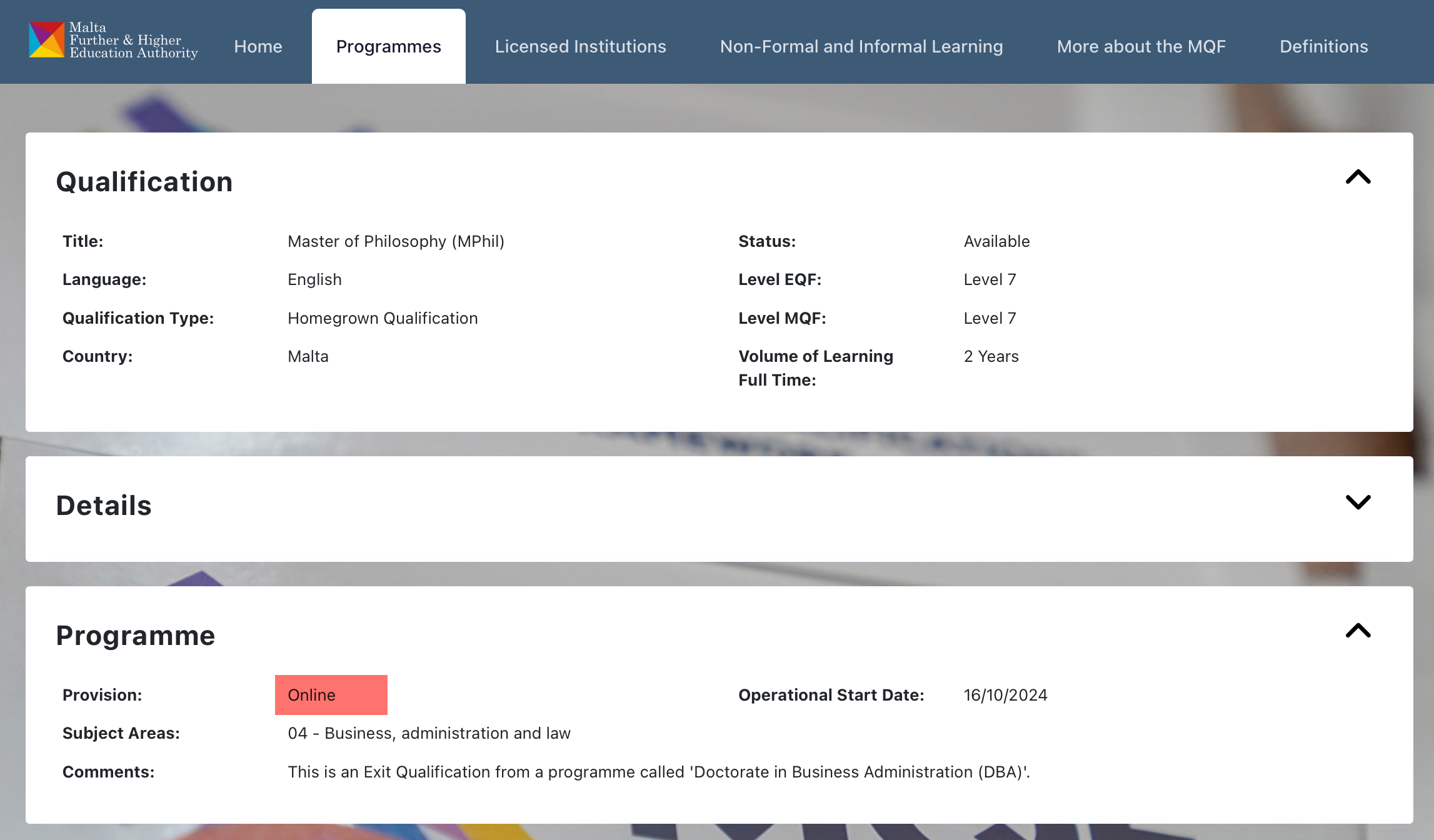
The programme is MFHEA-accredited, positioned at MQF Level 7, and referenced to the EQF.
Individually designed for each learner
Each learner’s study journey is individually designed, with dedicated supervisor support.
Scholarships Available
Scholarships may be available for eligible applicants, subject to admissions review and the scholarship assessment process.
Master of Philosophy (M.Phil)
Programme Details
Master of Philosophy (M.Phil) from EAI Malta
What is a Master of Philosophy (M.Phil)?
The Master of Philosophy (M.Phil) is a research-oriented Master’s degree commonly found within European higher education systems and many international academic environments. In Malta, an M.Phil may be positioned within the Malta Qualifications Framework (MQF) and referenced to the European Qualifications Framework (EQF), supporting transparency of level and academic comparability across countries.
In essence, the M.Phil differs from applied Master’s programmes such as the MBA or MSc because it places stronger emphasis on in-depth academic research. Learners are expected not only to acquire knowledge, but also to develop independent research capabilities. This includes identifying research problems, building theoretical frameworks, selecting appropriate research methods, and analysing data according to academic standards.
An important feature of the M.Phil is that it typically requires the completion of a research thesis, and in some cases a substantial research proposal. This process helps learners develop core competencies such as critical thinking, academic analysis, and evidence-based reasoning. For this reason, the M.Phil is often considered a strong preparatory step for doctoral programmes such as a PhD or academic DBA, especially at institutions with rigorous admission requirements.
Although positioned at Level 7, many M.Phil programmes may reflect a level of research intensity similar to the early stage of doctoral study. Therefore, graduates are not only awarded a Master’s-level qualification within the MQF and EQF context, but may also use their research outcomes as a foundation for further doctoral study at recognised higher education institutions.
In modern delivery models, the M.Phil programme may be supported through international academic platforms such as SwissEdu+, with academic support activities facilitated through institutions such as the Swiss Information and Management Institute. The degree may be awarded solely by partner higher education institutions, such as EuroAmerican Institute, in accordance with the regulations of the awarding education system.
What does it mean that the Master of Philosophy (M.Phil) is individually designed for each learner?
Master’s education can no longer be limited to pre-designed programmes, especially in a context where knowledge is increasingly accessible. Today, learners need not only a quality-assured qualification with international transparency, but also a learning journey that can support their career, research, entrepreneurship, or intellectual property development goals.
The Master of Philosophy (M.Phil) research Master’s programme, supported through SwissEdu⁺, is designed with this orientation: personalising the learning and research journey according to each learner’s needs, experience, ideas, and individual goals.
Key distinctive features:
- A personalised learning and research journey for each learner.
- Guidance on selecting the research field and implementation direction before enrolment.
- Appointment of supervisors and/or experts to support learners throughout the study and research process.
- Guidance for learners in developing their research outputs according to their own goals, such as research-based entrepreneurship, scientific publication, capital-raising preparation, research-based professional profiling, or direct application in real-world contexts.
The Master of Philosophy (M.Phil) supported through SwissEdu⁺ is designed as an innovative programme model for personalising a research Master’s journey, helping learners not only complete a qualification but also develop academic and applied outputs with practical value.
Modules
The Master of Philosophy (M.Phil) programme includes modules related to applied research and the completion of an M.Phil dissertation.
Practice-Based Research:
- Advanced Research Design and Methodologies
- Developing Research Capability
M.Phil Dissertation Stage:
- Dissertation Writing and Defence
Qualification Awarded
Upon graduation, students will receive:
- Master of Philosophy (M.Phil) awarded by EuroAmerican Institute, Malta.
Specialisations
M.Phil students may choose their graduation specialisation based on the topic of their Research.
Please note that the selected specialisation will be recorded on the academic transcript only and will not appear on the qualification. The final wording may be adjusted depending on the actual Capstone Project and the decision of the Academic Board. Candidates may also choose not to select a specialisation if they wish to maintain greater flexibility after graduation.
Some specialisations that M.Phil candidates may choose:
- Artificial Intelligence in Business
- Education Management
- TESOL
- Digital Transformation
- Corporate Finance
- Banking Leadership
- International Business
- Healthcare Management
- EdTech and Training Management
- Organisational Psychology
- Pharmaceutical Management
- Management Information Systems
- Business Analytics
- Logistics and Supply Chain Management
- Marketing and Brand Management
- Human Resource Management
- Investment and Wealth Management
- Entrepreneurship and Innovation
- Educational Experience Design
- And many other specialisations, depending on the Master’s practical research.
Entry Requirements
Admission through the typical route:
- A Bachelor’s qualification in Majors from accredited universities;
- Or a Level 6 qualification under the European Qualifications Framework (EQF) or an equivalent qualification.
English Requirements:
- English proficiency must be at least CEFR (Common European Framework of Reference) level B2 or IELTS 5.5
Learning Mode
Learners attend Live Class directly with lecturers from Swiss Information and Management Institute under the Live Class Direct™ model. Upon successful completion of the programme, learners receive the Master of Philosophy (M.Phil)
awarded by EuroAmerican Institute (EAI), Malta.
The programme is delivered through the SwissEdu⁺ Swiss Digital Higher Education model, in which Swiss Information and Management Institute focuses on academic delivery and learner support, while the qualification is awarded by EAI Malta.
The Live Class Direct™ model enables learners to study directly with Swiss Information and Management Institute, without franchise delivery or intermediaries. This helps maintain the original programme structure, ensure direct academic access, and reduce third-party delivery risks.
Academic Support System
Learners participating in programmes delivered through the SwissEdu⁺ digital higher education model are supported by a range of optional academic support activities designed to improve learning effectiveness and adaptability in an international academic environment.
The support activities are designed based on the principle of “Distance Not Distant”, focusing on accompanying learners throughout their study journey, including:
- Academic English support during the learning process.
- Live Classes supported by AI-assisted real-time translation technology, helping learners access content more effectively.
- Full class recordings, allowing learners to review lessons to reinforce knowledge and prepare for assessment.
- Assignment development guidance, including support on structure, content direction, and implementation methods in accordance with applicable academic requirements.
- Support in identifying and avoiding unintentional plagiarism, while increasing awareness of academic integrity standards.
Note: These support activities are supplementary, optional, and non-compulsory. They are designed to enhance the learning experience and learning effectiveness; they do not replace or interfere with the formal teaching, assessment, or awarding responsibilities of the education provider or awarding partner.
The programme is delivered through the SwissEdu⁺ digital higher education model, in which Swiss Information and Management Institute focuses on academic delivery and learner support and does not directly award the qualification, helping optimise costs for learners.
The Live Class Direct™ model allows learners to study directly with Swiss Information and Management Institute, without local training intermediaries, franchise arrangements, or third-party delivery. This helps preserve the originality of the programme, support access to the official academic pathway, and reduce risks from third parties.
Master of Philosophy (M.Phil)
Accreditation & Recognition of EAI Malta (EU)
Recognised by the Malta Further & Higher Education Authority (MFHEA)
EuroAmerican Institute (EAI) Malta is licensed and accredited by the Malta Further and Higher Education Authority (MFHEA), the competent authority responsible for the licensing, accreditation, and quality assurance of further and higher education in Malta.
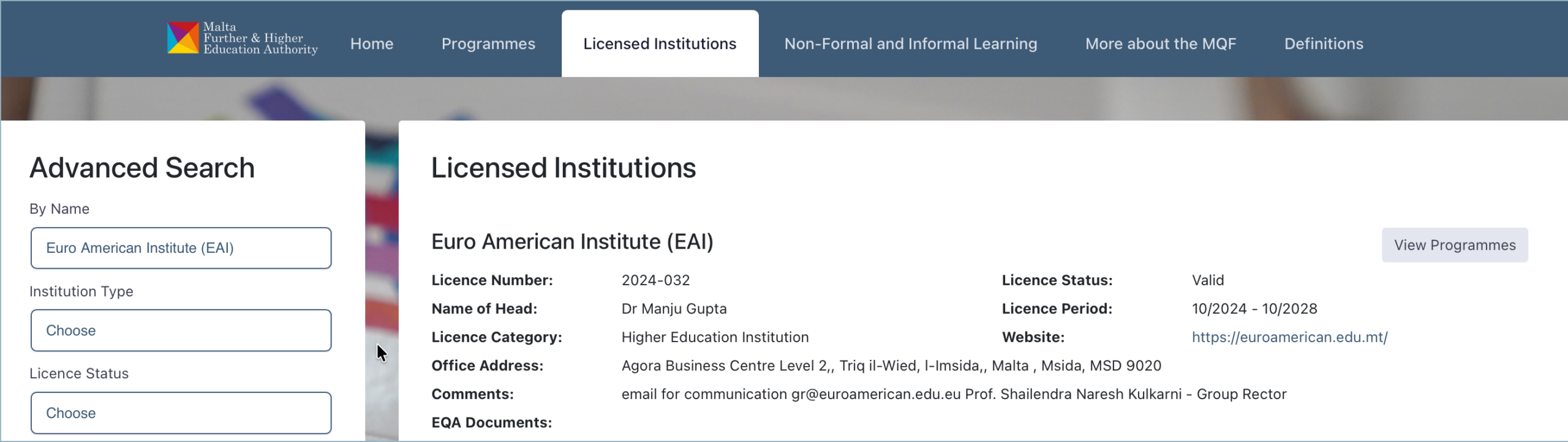
Under Higher Education Institution Licence No. 2024-032, EAI is licensed to operate as a Higher Education Institution in Malta. Its approved programmes are offered within the Malta Qualifications Framework (MQF) and referenced to the European Qualifications Framework (EQF), subject to the applicable MFHEA regulatory requirements.
As a higher education provider based in Malta, EAI operates within a country that is part of the European Union and the European Higher Education Area (EHEA). Its programmes may be structured using ECTS credits in line with European higher education practices, supporting transparency and comparability.
MFHEA oversees licensing, programme accreditation, and quality assurance in accordance with Malta’s regulatory framework for further and higher education. Programmes are referred to as accredited when they have been assessed by MFHEA and pegged to the Malta Qualifications Framework.
- The licence can be verified on the official MFHEA register HERE.
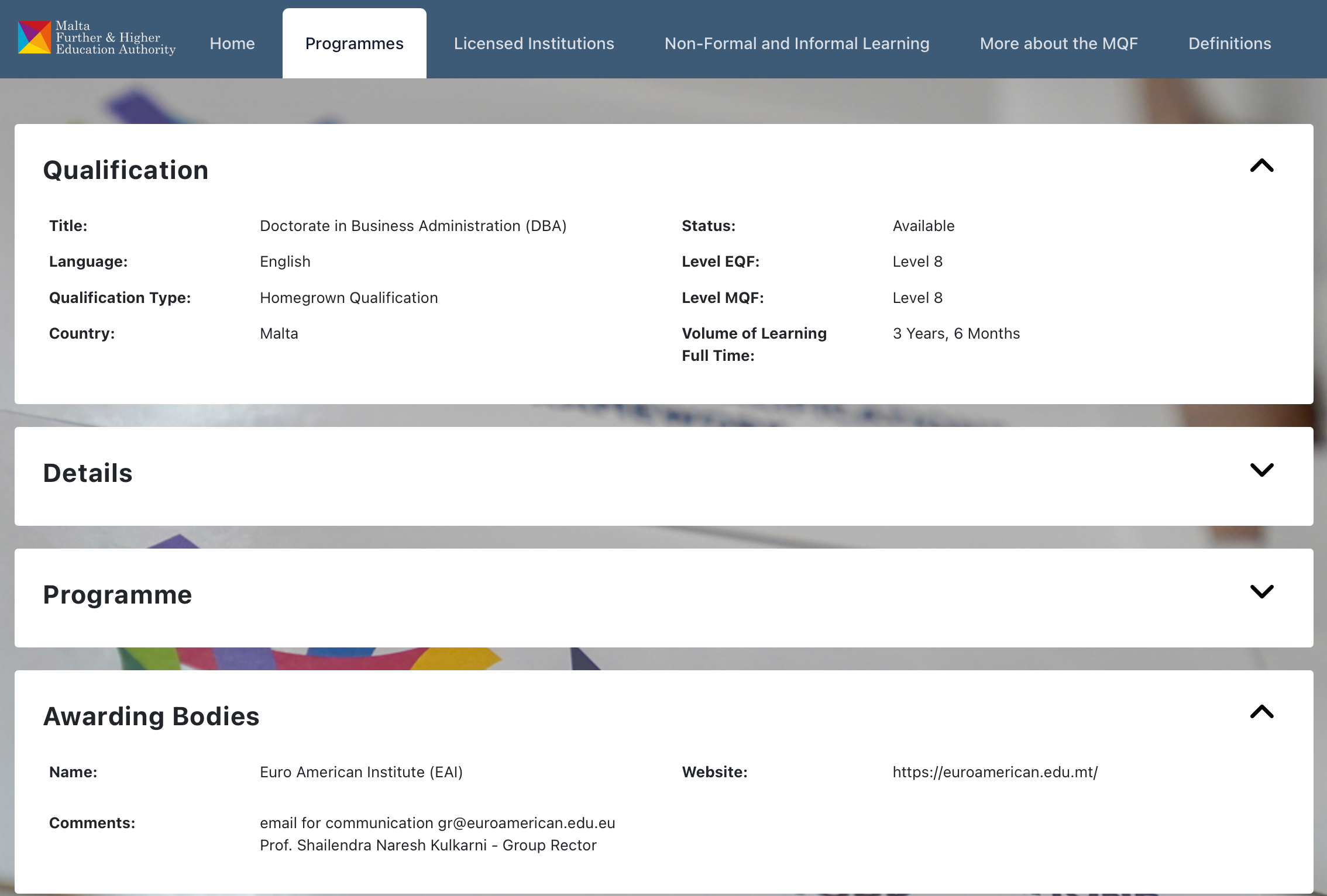
- Programme accreditation details can be verified on the official MFHEA register HERE.
- Video guide to verifying EAI and the programme through the MFHEA portal and understanding qualification recognition through MQRIC / Malta ENIC-NARIC HERE.
Recognition of the Online Learning Model - Aligned with SwissEdu⁺’s Swiss Digital Higher Education Framework
The programme is not only academically accredited; the online learning model for the Master of Philosophy (M.Phil) programme has also been approved by the Malta Further and Higher Education Authority (MFHEA).
This is an important distinction. As SwissEdu⁺ delivers its global learning model under the concept of Swiss Digital Higher Education, approval of the programme’s online delivery model helps provide a formal and recognised framework for online study and academic delivery, supported by MFHEA’s regulatory oversight.
Verify MFHEA’s approval of the online delivery model HERE.
European Qualifications Framework (EQF) and the Bologna Process
EAI qualifications are pegged to the Malta Qualifications Framework (MQF), which is referenced to the European Qualifications Framework (EQF). This supports transparency and comparability in international academic contexts.
The Lisbon Recognition Convention is the principal legal instrument for the recognition of higher education qualifications in the European region. It is administered by the Council of Europe and UNESCO and, as of 1 July 2025, has 57 Contracting Parties. Recognition decisions remain subject to the policies of the receiving institution or competent authority.
As part of the broader European higher education architecture associated with the Bologna Process, ECTS may be used to support transparency, comparability, and credit transfer. In Malta, recognition information is provided through MQRIC, the official ENIC-NARIC centre within MFHEA.
- Reference to the Malta ENIC–NARIC Network HERE
European Credit Transfer and Accumulation System (ECTS)
Malta is a member of the Bologna Process and part of the European Higher Education Area (EHEA). Within this framework, ECTS supports transparency, credit accumulation and transfer, and the recognition of study periods across European higher education systems.
The European Qualifications Framework (EQF) serves as a common reference framework to make qualifications easier to understand and compare across Europe.
As a licensed higher education institution in Malta, EAI may award qualifications within the scope of its licence and accredited programmes. These qualifications may be considered for recognition by receiving institutions or competent authorities, subject to their own rules and procedures.
- Information on ECTS HERE
MFHEA and ENQA
The Malta Further and Higher Education Authority (MFHEA) is an Affiliate Member of the European Association for Quality Assurance in Higher Education (ENQA).
ENQA is a European association dedicated to quality assurance in higher education and plays an important role in the development of quality assurance policy and cooperation within the European Higher Education Area (EHEA).
MFHEA’s Affiliate Member status reflects its participation in the wider European quality assurance community and its engagement with quality assurance developments associated with the Bologna Process and the ESG 2015 framework.
- Information on MFHEA and ENQA HERE
Recognition Information via ENIC-NARIC
The ENIC-NARIC Networks bring together national information centres that provide information and guidance on the recognition of qualifications across participating countries. These networks operate within the broader framework of the Lisbon Recognition Convention.
In Malta, the Malta Qualifications Recognition Information Centre (MQRIC), within the Malta Further and Higher Education Authority (MFHEA), is the official ENIC-NARIC centre. It provides recognition and comparability advice for qualifications and assists with the recognition of Maltese qualifications abroad.
Accordingly, qualifications awarded by licensed and, where applicable, accredited higher education providers in Malta may be considered for academic or professional recognition by receiving institutions or competent authorities, subject to their own rules and procedures.
- For further information on ENIC–NARIC, please visit HERE
Recognition of Comparability in South Africa
South African Qualifications Authority (SAQA) is the statutory authority responsible for the management and oversight of the South African National Qualifications Framework (NQF), and for ensuring compliance with national values and quality standards within the qualifications recognition system.
According to SAQA’s comparability assessment outcomes, a Master qualification awarded in Malta, Europe is recognised by SAQA as a Master qualification within the national qualifications benchmarking system, in accordance with South Africa’s assessment framework and recognition criteria.
Such recognition is carried out within the scope of SAQA’s statutory authority and serves academic benchmarking, professional, and qualifications management purposes, in line with the official assessment procedures of South Africa’s national qualifications authority.
- View more HERE
Recognition of Comparability in New Zealand
The New Zealand Qualifications Authority (NZQA) is the national authority responsible for maintaining the New Zealand Qualifications and Credentials Framework (NZQCF) and for evaluating overseas qualifications through its International Qualification Assessment (IQA) process.
Where an overseas qualification is submitted to NZQA for assessment, NZQA may evaluate how that qualification compares with a qualification type or level on the NZQCF, based on the individual case and the evidence provided.
In New Zealand, a Master’s Degree is positioned at Level 9 on the NZQCF. Any comparison between an overseas Master’s qualification and a New Zealand Master’s Degree should therefore be presented only on the basis of a specific NZQA assessment outcome.
This assessment is conducted under NZQA’s official procedures and is not automatic. The outcome depends on the qualification submitted and the supporting documentation provided.
- View more HERE
Recognition of Comparability in Italy
The Automatic Recognition Database Italia (ARDI) is a tool developed by CIMEA to support the automatic correspondence of qualifications issued in countries that are signatories to the Lisbon Recognition Convention. It is designed in line with the European approach to automatic recognition in higher education.
Through ARDI, eligible qualifications may obtain a statement of correspondence with the relevant level of the Italian higher education system, subject to the scope of the database and the applicable procedures of the receiving institution or competent authority.
Where applicable, master’s-level qualifications may be referenced in line with the second cycle of the Qualifications Framework of the European Higher Education Area (QF-EHEA), depending on the specific qualification and the official ARDI result.
This supports academic progression and recognition processes in Italy, subject to the rules and authority of the relevant Italian institution or authority.
- View more HERE
Recognition of Comparability in Lithuania
Study Quality Evaluation Center – Lithuania’s authority for the evaluation and quality assurance of education – has conducted an Education Credential Assessment (ECA) for qualifications awarded in Malta.
According to the relevant assessment outcome, the master’s qualification awarded in Malta may, in an individual case, be recognised as comparable to a Master’s-level qualification within the Lithuanian qualifications system, subject to the official decision of the competent authority.
- View more HERE
Recognition of Comparability in Australia
Educational Qualification Assessment
Qualifications awarded by higher education institutions in Malta (Europe) may be assessed by relevant Australian qualification assessment authorities for comparability in terms of level within the Australian Qualifications Framework (AQF), depending on the purpose of assessment and the documentation provided.
Such assessment is conducted through the official procedures of the relevant Australian authority or assessment body and may support applications for further study, employment, professional review, and/or migration, subject to the requirements of the receiving institution, profession, or authority.
- View more HERE
Recognition of Comparability in Nigeria
Electronic Transcript Exchange and Certificate Verification System (Nigeria)
Nigeria’s Electronic Transcript Exchange and Certificate Verification System has carried out an assessment in relation to qualifications awarded in Malta.
According to the assessment results, master’s qualifications from Malta may be considered comparable to master’s-level qualifications within the Nigerian education system. This indicates comparability for the purposes of qualification verification, further study, and/or professional use, subject to the rules and authority of the receiving system.
- View more HERE
Recognition of Comparability in Norway
Norwegian Directorate for Higher Education and Skills (Norway)
The Norwegian Directorate for Higher Education and Skills (HK-dir) is the competent authority in Norway for the recognition of foreign higher education qualifications.
Qualifications awarded by higher education institutions in Malta (Europe) may be assessed by HK-dir to determine whether they can be considered equivalent, in level and scope, to higher education qualifications within the Norwegian system, in accordance with the applicable regulations and assessment criteria.
Such assessment is carried out through official procedures and may support applications for further study, employment, or institutional and professional review, subject to the documentation submitted and the requirements of the receiving institution, employer, profession, or authority.
- View more HERE
Recognition of Comparability in the UK
UK National Information Centre for the Recognition and Evaluation of International Qualifications and Skills (UK ENIC)
UK ENIC is the United Kingdom’s national information centre for the recognition and evaluation of international qualifications and skills. The service is operated by Ecctis on behalf of the UK Department for Education.
Based on UK ENIC assessment procedures, qualifications awarded in Malta may be assessed as comparable to qualifications at the corresponding level within the United Kingdom’s qualifications system, depending on the specific qualification and supporting documentation.
For example, an overseas master’s qualification may be assessed by UK ENIC as comparable to a UK master’s qualification for academic and professional comparison purposes, subject to the specific case and UK ENIC’s assessment process.
- View more HERE
Recognition of Comparability in the United Arab Emirates
The UAE Ministry of Education (MoE) operates the recognition system for university certificates issued outside the United Arab Emirates, subject to the applicable regulations, documentation requirements, and the scope of review of the competent authority.
Recognition is not automatic and depends on the nature of the qualification, the submitted documents, and the requirements of the relevant authority or institution in the UAE.
- View more HERE
Recognition of Comparability in Finland
Finnish National Agency for Education (Finland)
The Finnish National Agency for Education may assess qualifications awarded in Malta as comparable, in terms of level, to qualifications within the Finnish higher education system, depending on the specific qualification and the purpose for which recognition is sought.
Such recognition or comparability is considered in accordance with the authority and assessment procedures applicable in Finland, for academic and/or professional purposes. It is not automatic and depends on the specific qualification file, the intended use of the qualification, and the rules of the receiving institution, employer, or competent authority.
- View more HERE
Recognition of Comparability in Poland
Polish National Agency for Academic Exchange (Poland)
The Polish National Agency for Academic Exchange has recognised qualifications awarded by higher education institutions in Malta (Europe) as being at the corresponding comparable level within the Polish higher education system.
Specifically, the Master’s qualification has been identified as comparable to second-cycle studies in Poland, in accordance with the applicable qualifications framework and recognition regulations of the Polish higher education system.
Such recognition is carried out under the authority and assessment procedures of the receiving body for the purposes of further study and/or professional use, and is not automatic, but depends on each individual case.
- View more HERE
Recognition of Comparability in France
French Republic (France)
France, through ENIC-NARIC France, participates in the ENIC-NARIC Networks, the international network for information and recognition of qualifications operating in line with the principles of the Lisbon Recognition Convention.
Within this framework, qualifications awarded in Malta may be assessed as being at a corresponding comparable level for academic and/or professional purposes, subject to the authority and assessment procedures of the receiving institution or competent authority in France.
- View more HERE
Recognition of Comparability in the Netherlands
Internationale Diplomawaardering (Netherlands)
International Credential Evaluation (IDW) is the Dutch service for evaluating foreign diplomas by comparing them with the Dutch education system. A credential evaluation indicates which level in the Dutch education system is comparable to a foreign diploma.
Qualifications awarded by higher education institutions in Malta (Europe) may be evaluated for comparability with Dutch higher education qualifications, in accordance with the applicable evaluation procedures and the principles used in the Netherlands.
Where relevant, a Master’s qualification may be evaluated as comparable to a Dutch Master’s degree, depending on the specific qualification, supporting documentation, and the outcome of the individual assessment.
A credential evaluation is an official assessment document, but it is not legally binding and does not in itself guarantee admission, employment, or automatic recognition. Final decisions remain subject to the requirements of the receiving institution, employer, profession, or authority.
- View more HERE
Recognition of Comparability in Sweden
Swedish Council for Higher Education (Sweden)
The Swedish Council for Higher Education is Sweden’s centre within the ENIC-NARIC Networks, the international cooperation framework for information and recognition of qualifications, operating in line with the principles of the Lisbon Recognition Convention.
Within this framework, qualifications awarded in Malta may be assessed by the Swedish Council for Higher Education as comparable to qualifications at the corresponding level in the Swedish education system, for academic and/or professional comparison purposes, subject to the authority and assessment procedures applicable in Sweden.
- View more HERE


Master of Philosophy (M.Phil)
Frequently Asked Questions
SwissEdu⁺
Which institution awards the qualification?
The qualification awarded is:
Master of Philosophy (M.Phil) – awarded by EuroAmerican Institute (EAI), Malta.
Is the qualification accredited or recognised by a government authority?
Yes.
EAI is a licensed higher and further education institution under the Malta Further and Higher Education Authority (MFHEA).
Is the qualification recognised in Malta and Europe?
Yes.
- The Master of Business Administration awarded by EuroAmerican Institute (EAI), Malta, may be verified through the official registers of the Malta Further and Higher Education Authority (MFHEA). Malta is a member of the European Union, and its qualifications framework is referenced to the European Qualifications Framework (EQF).
- Malta also participates in the ENIC-NARIC Network through MQRIC, which supports qualification comparability and recognition information internationally. Recognition outside Malta is not automatic and remains subject to the requirements of the receiving institution or authority.
References:
- Verify the institution through the Malta Further and Higher Education Authority (MFHEA) portal HERE.
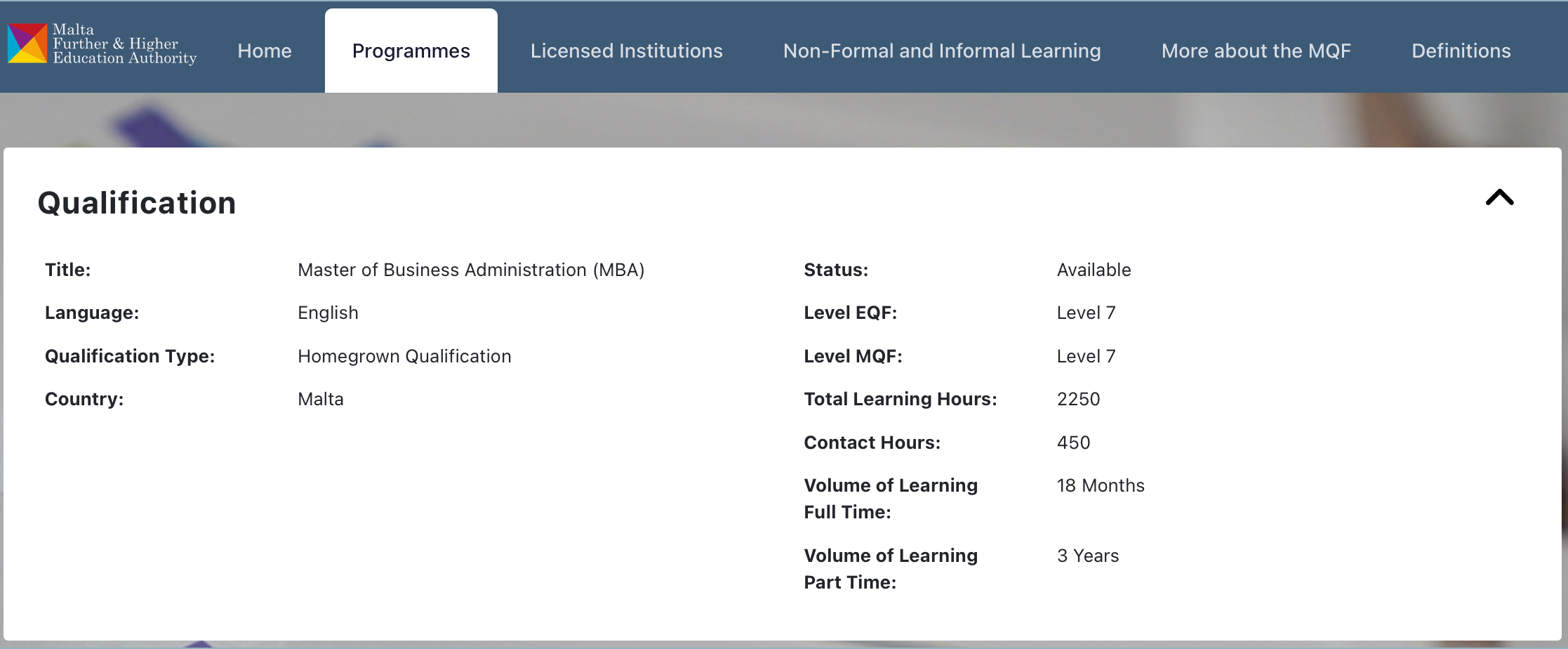
- Verify the Master of Business Administration programme through the MFHEA/Malta Qualifications Database HERE.
- Watch the video guide on how to verify the institution and programme through the MFHEA portal and understand qualification recognition through MQRIC / Malta ENIC-NARIC HERE.
- Verify how the Malta Qualifications Framework is referenced to the European Qualifications Framework HERE.
- Verify Malta’s participation in the ENIC-NARIC network through MQRIC HERE.
Does the programme include an academic support system?
Yes.
The programme includes academic support system, formatting assistance, plagiarism checking, and in-depth research guidance.
What is SwissEdu⁺ – Swiss Digital Higher Education?
SwissEdu⁺ is a Swiss digital higher education platform that provides the academic and technological infrastructure for delivering higher education and postgraduate programmes in a digital environment, through a model of standardisation, digitalisation, and cross-recognition of learning outcomes.
Are scholarships available?
Yes.
Scholarships may be available. Please contact the admissions team for further information and eligibility assessment.
What is Live Class Direct™?
It is an online delivery model with Live Class delivered directly by the Swiss Information and Management Institute.
This model ensures that the programme is delivered directly – non-joint, with no franchises and no intermediaries – helping learners study directly and reducing risks associated with third parties.
Why choose Malta, and how is Malta’s education system recognised internationally?
Why Malta?
Malta is a modern European island nation located in the Mediterranean and a member of the European Union since 2004. It is widely recognised for its stable economy, strong quality of life, international outlook, and English-speaking environment.
A High-Income EU Economy
According to the World Bank, Malta is classified as a high-income economy, reflecting strong levels of income, development, and economic resilience.
Stable Labour Market
Recent national statistics from the National Statistics Office Malta indicate strong employment participation and low unemployment, supporting Malta’s reputation as a stable and business-friendly economy.
Very High Human Development
According to the United Nations Development Programme, Malta is ranked among countries with very high human development.
Trusted European Education Environment
Malta’s education system operates within the wider European qualifications environment. The Malta Qualifications Framework is referenced to the European Qualifications Framework, supporting transparency, comparability, and learner mobility across Europe.
Key Advantages of Malta
- Member state of the European Union
- Uses the Euro
- English is an official language
- High-income economy
- Safe and welcoming environment
- International business hub
- Education aligned with wider European frameworks
References:
- European Commission. (2025). Education and training monitor: Malta. Publications Office of the European Union. https://op.europa.eu/webpub/eac/education-and-training-monitor/en/monitor-toolbox/country-page/malta.html
- National Statistics Office Malta. (2025). Key indicators for Malta compared with EU27. https://nso.gov.mt/key-indicators-for-malta-compared-with-eu27/
- United Nations Development Programme. (2024). Human Development Report Data Center. https://hdr.undp.org/data-center/human-development-index
- World Bank. (2025). World Bank country and lending groups: Country classification. https://datahelpdesk.worldbank.org/knowledgebase/articles/906519-world-bank-country-and-lending-groups
- World Bank. (2025). Malta overview. https://www.worldbank.org/en/country/malta
Note
The information presented above is provided for general reference based on official sources issued by relevant public authorities, together with applicable national and international qualifications frameworks.
In accordance with international practice, the recognition of qualifications and qualification levels is not automatic. Each country, receiving institution, employer, professional body, or competent authority may apply its own regulations, procedures, and assessment criteria. Learners are strongly advised to verify the recognition status and level of acceptance of any qualification in the jurisdiction where they intend to use it before enrolling in the programme.
Programmes delivered through the SwissEdu⁺ system are developed with a competence-based and profession-oriented approach to support career development in multinational business environments, international organisations, and cross-border professional contexts.
Accordingly, SwissEdu⁺ programmes are primarily designed for private-sector, international, and professional development purposes, and may not be intended to satisfy recruitment, appointment, licensing, teaching, or professional recognition requirements within public-sector systems or domestic public education administration frameworks.
Related reference information, descriptions, and framework statements may be updated from time to time in line with changes made by relevant authorities, regulatory bodies, or other competent institutions.
REGISTER FOR A 1:1 CONSULTATION
We understand that you need in-depth and personalized information tailored to your specific goals. Please provide your details, and we will contact you shortly. All of your information will be kept strictly confidential.
SwissEdu⁺ – Swiss Digital Higher Education
Blegistrasse 7, 6340 Baar, Switzerland
- Phone: +41 76 236 28 84
- support@simiswiss.ch